Your judgment, written down.
And version-controlled.
A skill is a document, not a fine-tune: the decision rules, the exceptions and what good looks like, in language the person who owns that process can read and correct.
The person who owns refunds can fix the refund rule.
Encoding a policy usually means describing it to an engineer, who turns it into a prompt you cannot read back. A skill removes the translator: it is prose with rules in it, and the person whose judgment it captures can open it and say whether it is right.
- A change is a diff What moved, who moved it, when. Roll it back and the behavior goes with it.
- No retraining The correction applies on the next run rather than the next training cycle.
- It travels Change model provider and the skills come with you. They are files, not weights.
What is in play for a run is a thing you can point at.
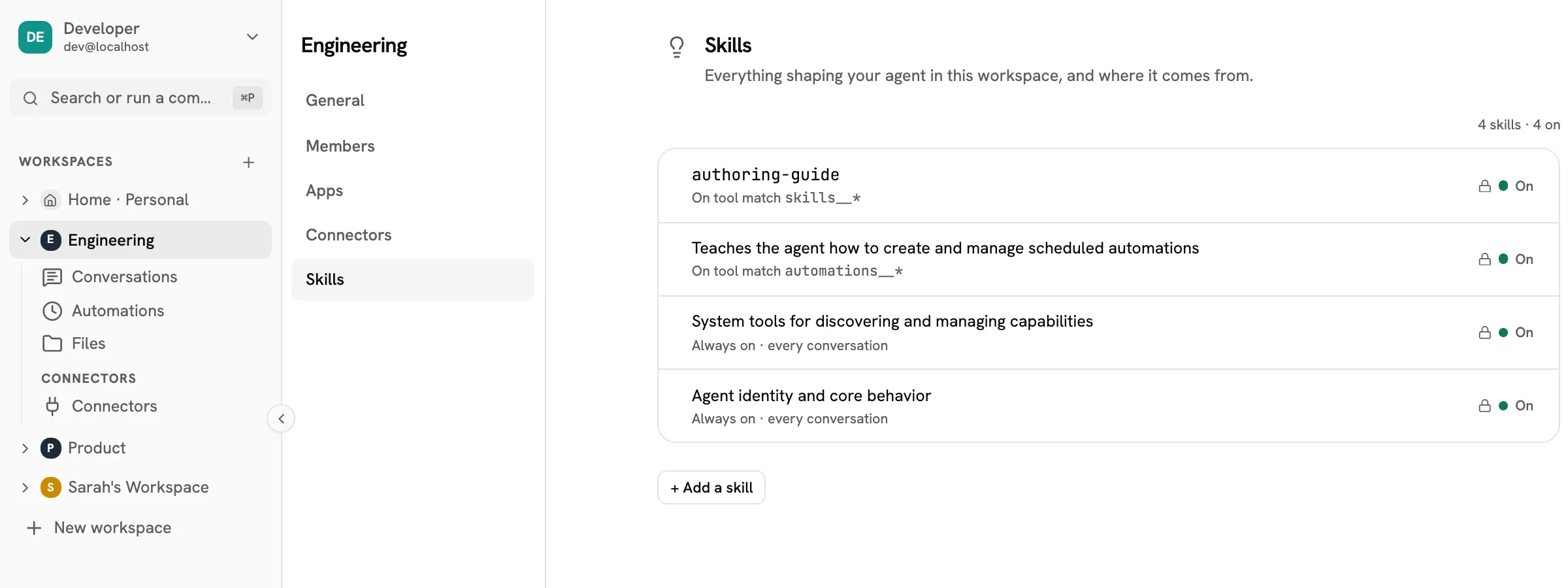
A skill is on or off per workspace, and fires either always or when the agent reaches for a tool it is bound to. Tone and escalation rules stay on; guidance about one system arrives only when that system is in play.
- Per workspace Finance runs finance rules. Support does not inherit them by accident.
- Always or on a tool match Two triggers, so a skill is not loaded into every conversation it does not concern.
- Connectors bring their own An app can ship guidance on when to reach for it, overridable per workspace.
Skills
Questions people ask about skills
What is an agent skill?
How is a skill different from fine-tuning a model?
Who is supposed to write them?
When does a skill actually load?
Can an app bring its own skill?
What stops skills contradicting each other?
More of the platform
Each capability has a page. These are the ones nearest this.
-
Workflow automation
Scheduled agents that run a described process
-
MCP apps
Apps your team builds, delivered over MCP
-
Built-in apps
To-dos, a CRM, memory and more, ready for agents
-
Integrations
Connectors for the systems you already run
-
MCP gateways
Remote MCP servers from any registry
-
Security
Workspace isolation and per-user access